
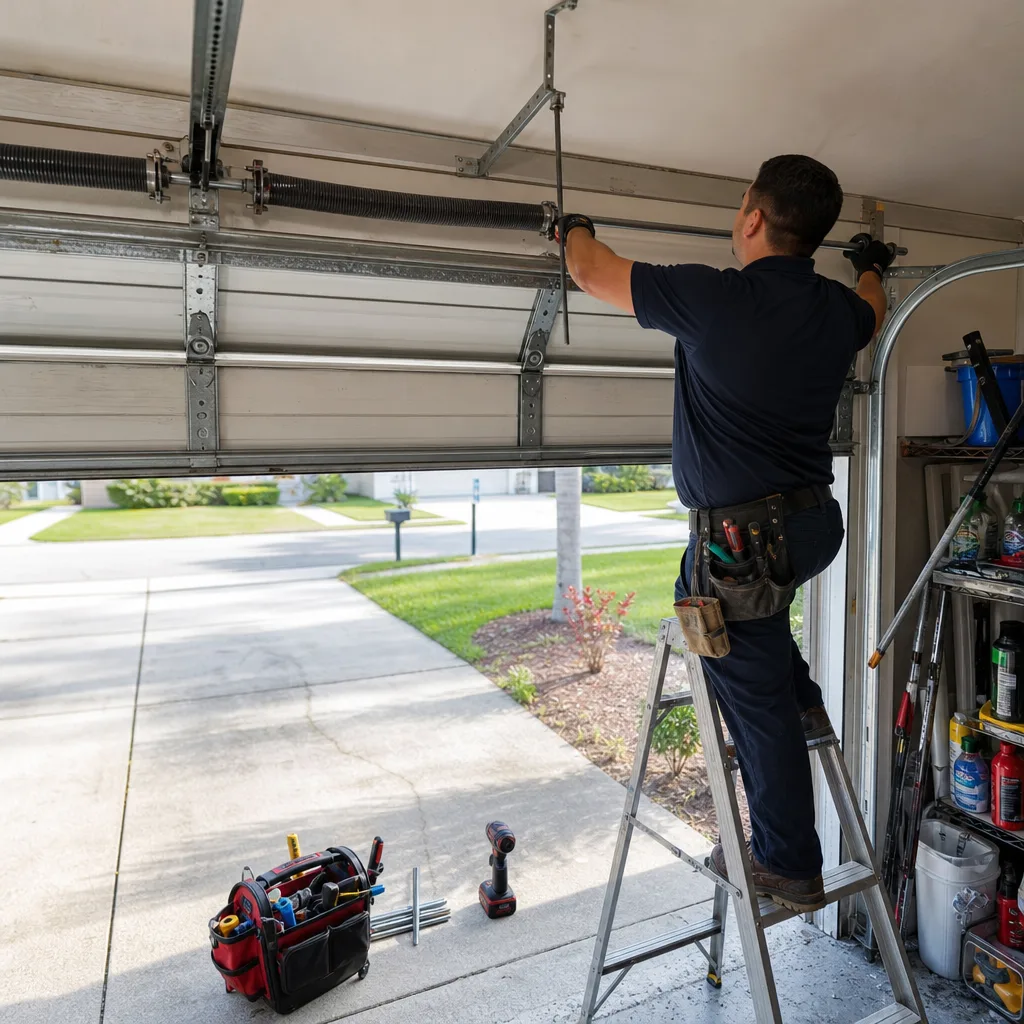
Last updated October 16, 2026
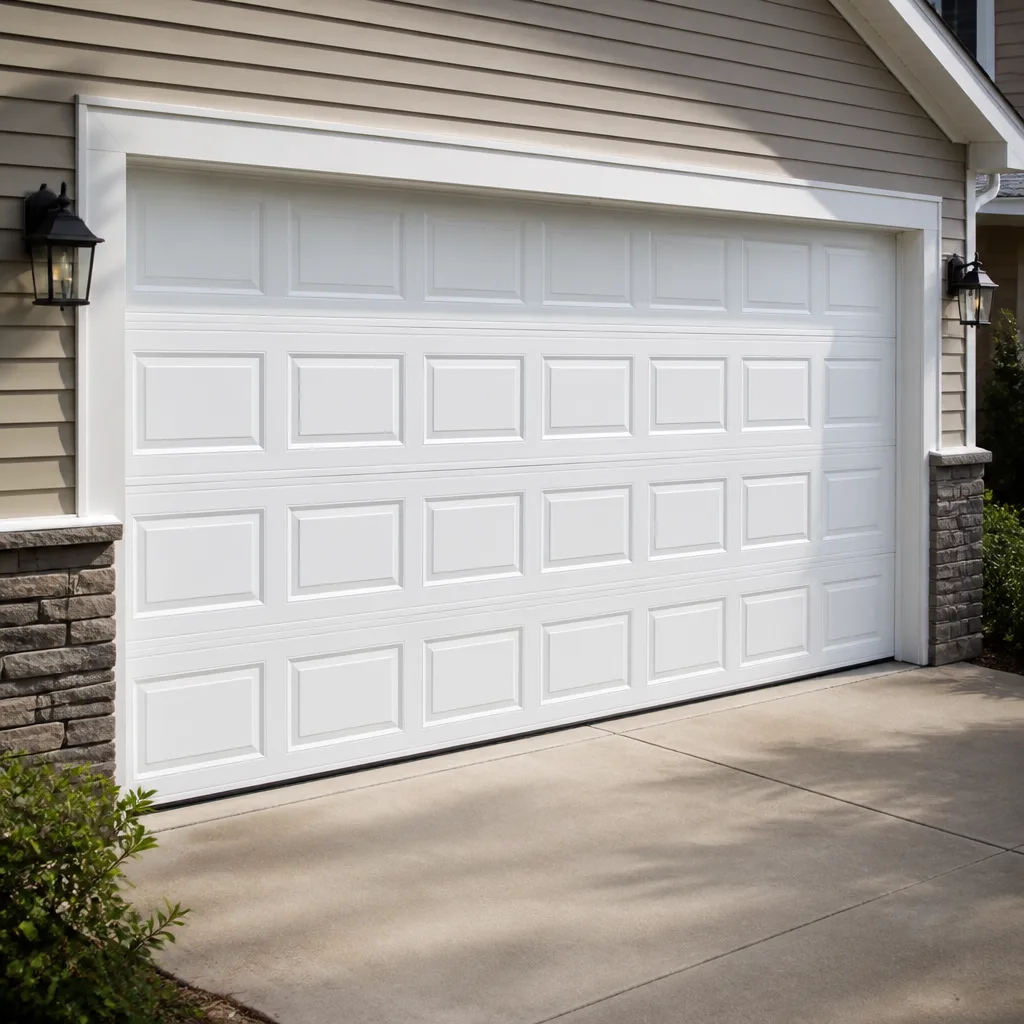 Raised-panel steel
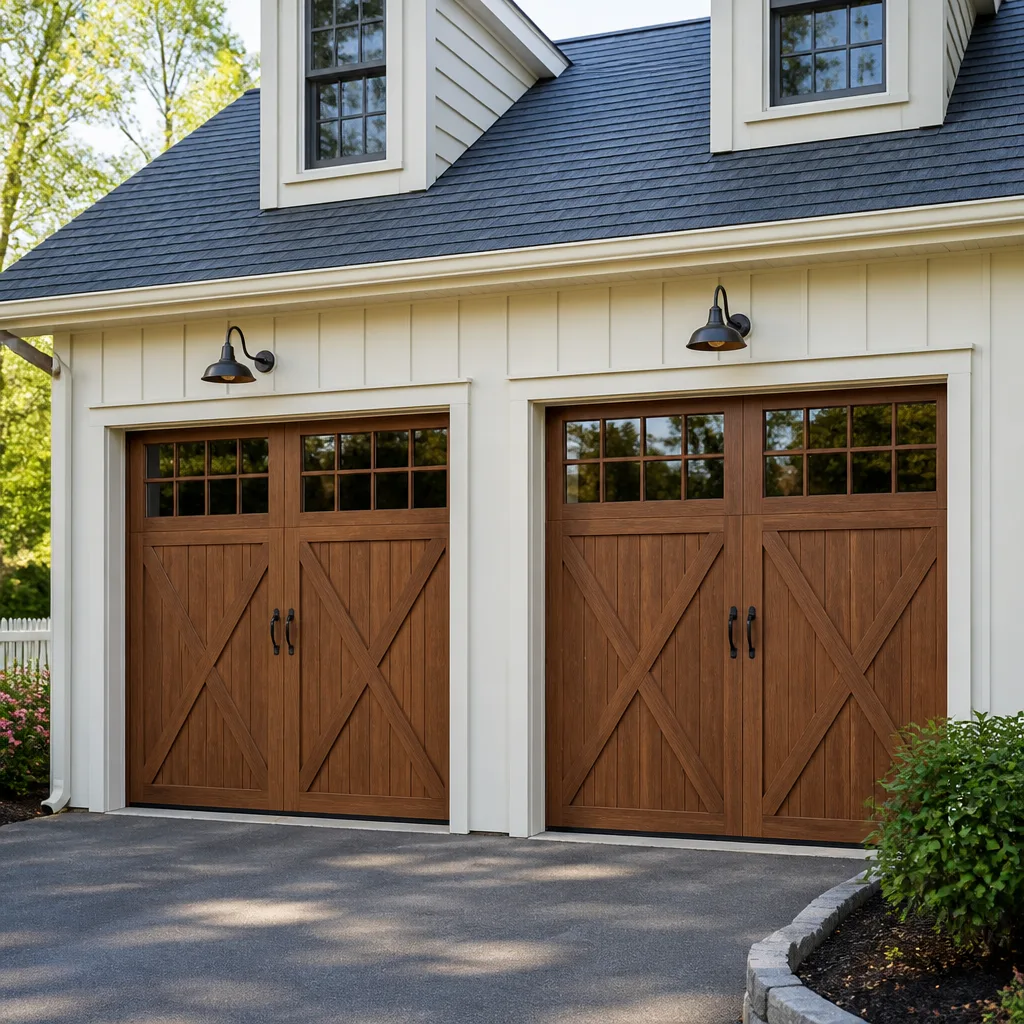 Carriage house
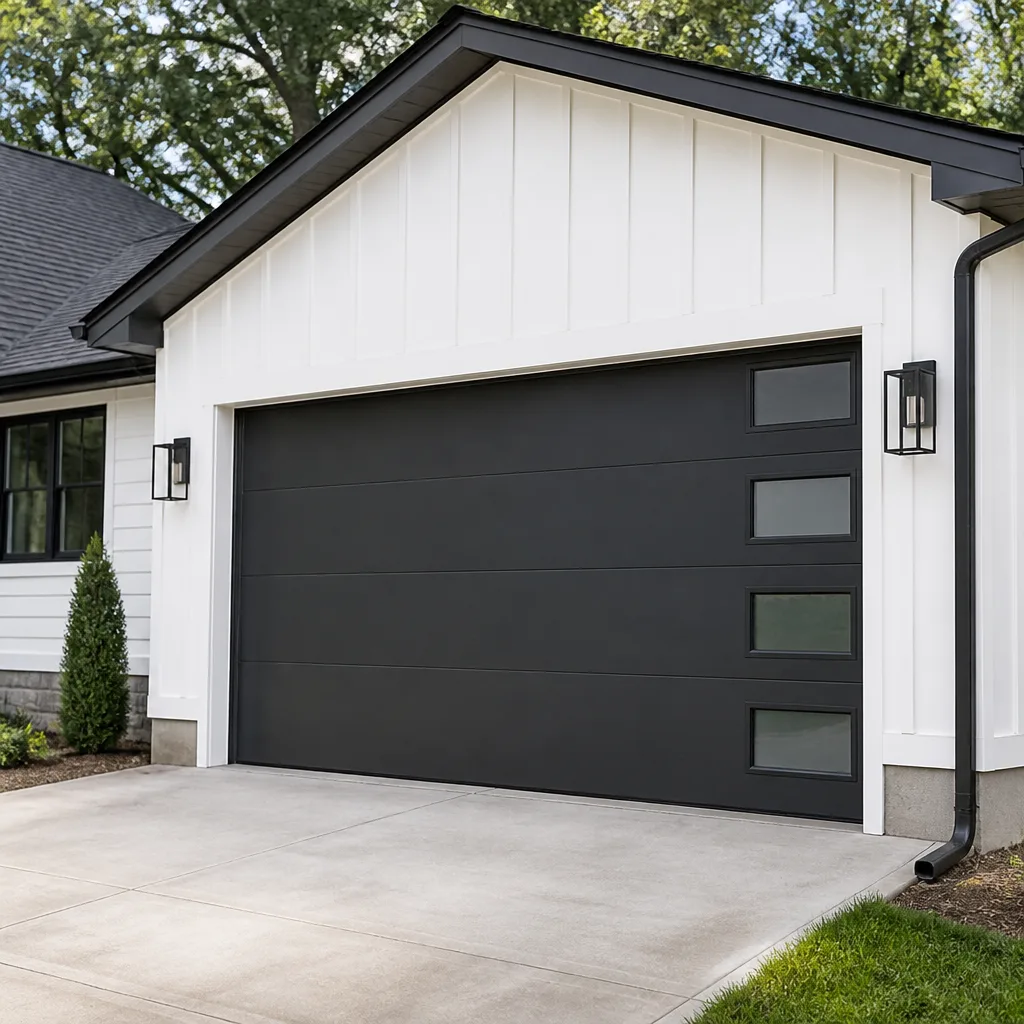 Modern flush
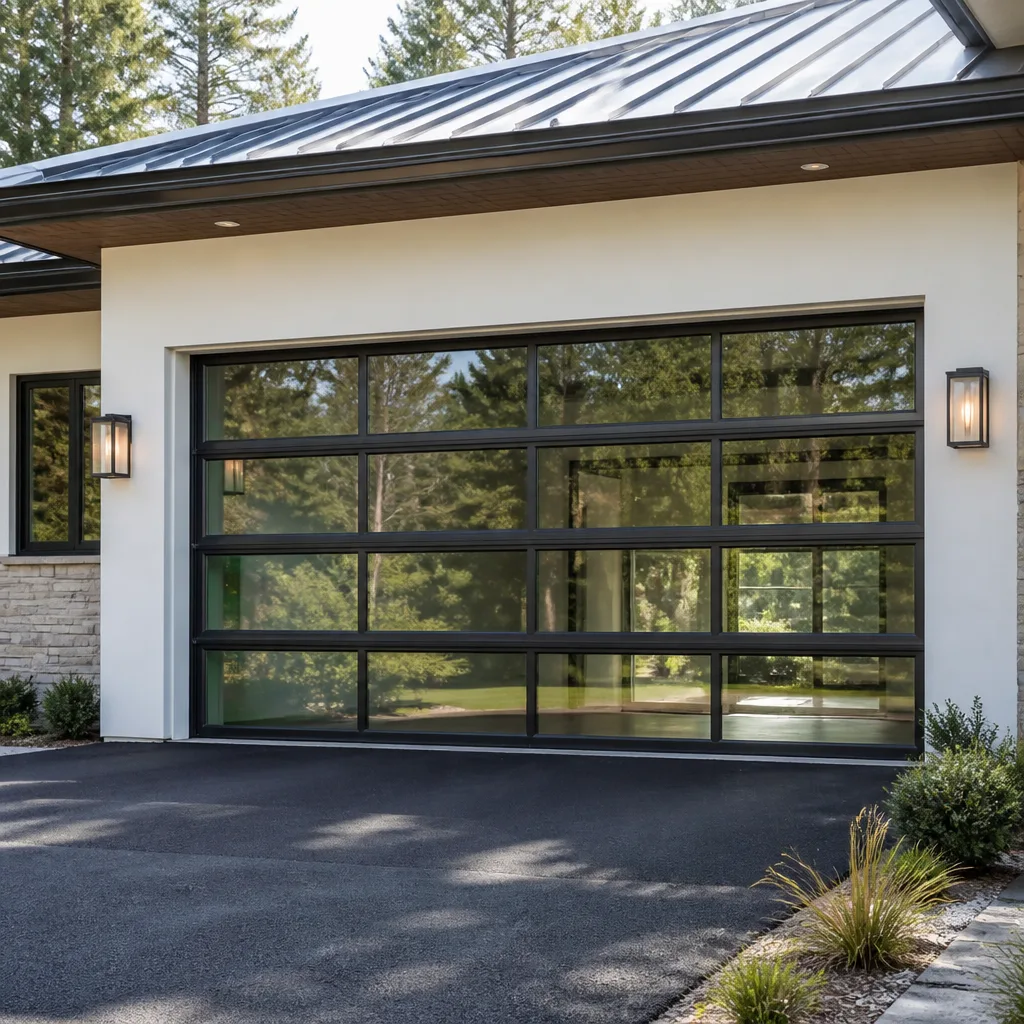 Full-view glass
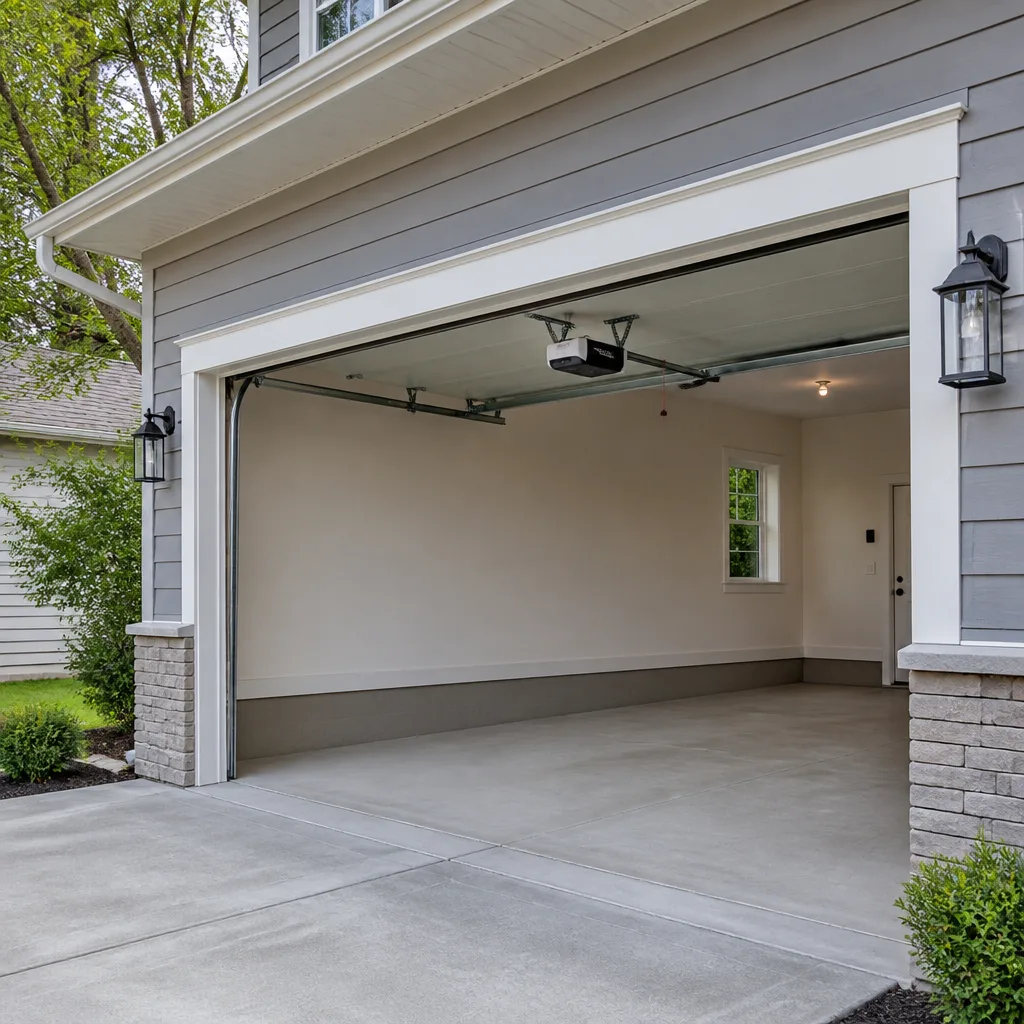 LiftMaster openers
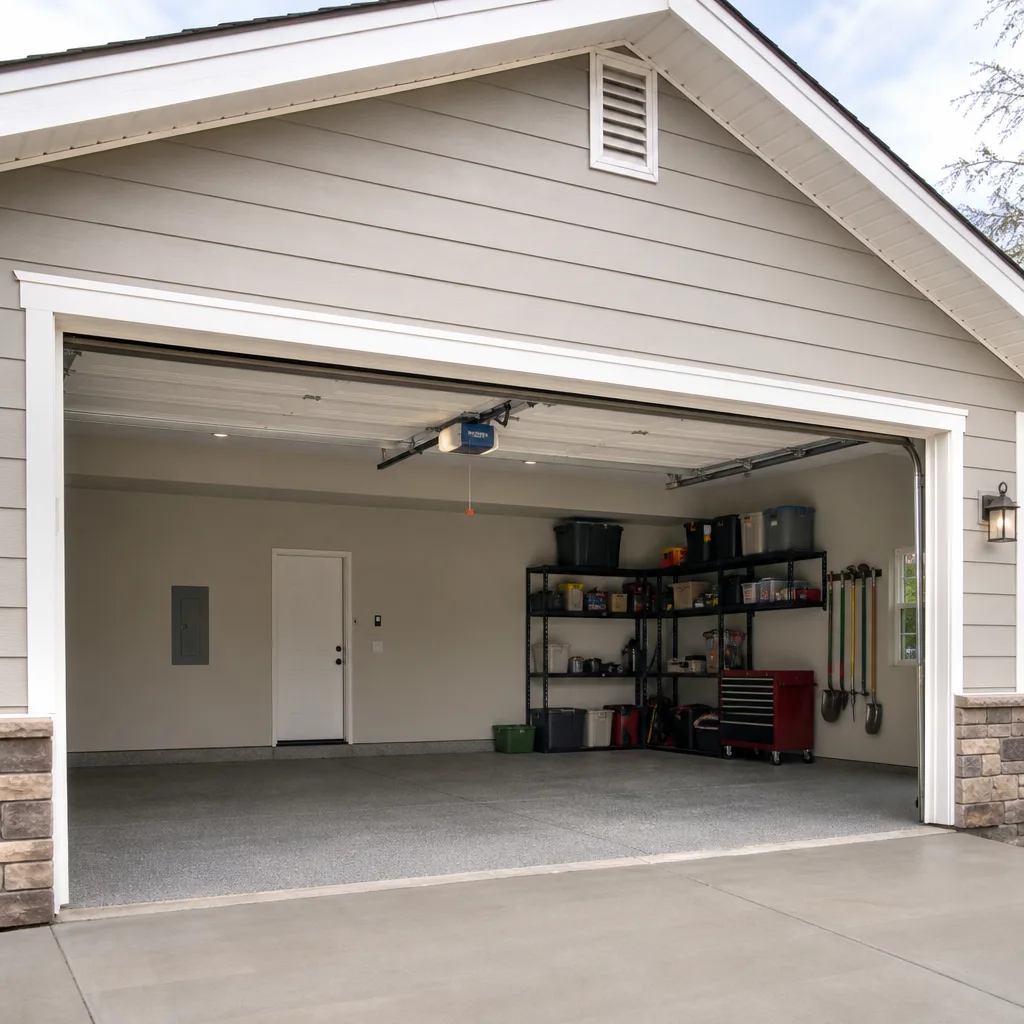 Chamberlain openers
Full 25-point door and opener safety check with every visit - springs, cables, rollers, tracks, and your LiftMaster or Chamberlain opener included
You get a price before we start. It does not change when the truck arrives.
Get your free estimateThe Complete Guide to Garage Door in Orlando
Orlando averages 53 inches of rain per year. That’s more than Seattle. And here’s the part most garage door guides miss: that moisture doesn’t just fall from the sky and drain away. It lingers. It condenses on metal surfaces at dawn. It combines with salt air drifting inland from the Atlantic and Gulf coasts. Then it attacks the springs, cables, hinges, and tracks that make your garage door work. This guide is written from inside Orlando specifically, for Orlando homeowners, and it covers everything from corrosion patterns we see in specific neighborhoods to what hurricane-rated doors actually mean under Orange County code. For more guides & resources on keeping your door functional year-round, see our full library.
Styles & brands we work with
Quick Answer
A garage door in Orlando needs to be understood as a system fighting a hostile climate: high humidity, salt-air drift, intense UV exposure, and seasonal hurricane-force winds. Repairs in Orlando typically run $125 to $450 depending on the component, and spring replacement averages $150 to $290 per spring. Choosing materials and hardware rated for Central Florida’s specific conditions, plus scheduling annual maintenance before June, will save you thousands over the life of the door.
Table of Contents
- What Makes Orlando Different for Garage Doors
- How Orlando’s Climate Attacks Your Garage Door Parts
- Choosing the Right Door Material for Florida UV and Humidity
- Hurricane-Rated Doors and Orange County Code: What You Actually Need
- The Real Cost of Garage Door Services in Orlando
- The Orlando Garage Door Maintenance Calendar
- Salt-Air Drift and Corrosion in Central Florida Zip Codes
- Common Mistakes to Avoid
- When to Call a Professional
- Frequently Asked Questions
- The Bottom Line
What Makes Orlando Different for Garage Doors
Most garage door advice online is written generically, as if a door in Phoenix behaves the same as a door in Orlando. It doesn’t. Phoenix gets 9 inches of rain a year. Orlando gets 53. Phoenix has low humidity and mild wind. Orlando has dew points above 70 for most of the summer and sits in the path of Atlantic hurricane seasons that can produce 100-plus mph gusts. That changes everything about which parts fail, when they fail, and what you should buy or replace them with.
We’ve replaced hardware in Orlando homes less than five years old that looks like it belongs in a coastal fishing village. The speed of degradation surprises homeowners every time. A steel torsion spring in a dry climate might last 10 years. In Orlando, with daily condensation cycles and salt-laden air, the same spring can rust and snap in 6 years or less. The metal oxidizes faster. The lubrication breaks down sooner. The cables fray where you can’t see them until the door suddenly won’t lift.
Then there’s the housing stock itself. Orlando’s tract home boom built thousands of stucco-over-CMU homes with garage door tracks anchored into stucco or concrete block rather than wood framing. That’s different from most of the country, where tracks mount to wooden studs. When a track pulls loose in an Orlando home, the fix involves different anchors, different fasteners, and a different repair approach than the generic YouTube tutorial shows.
This guide from Marlow Garage Door Repair Orlando home is built for that reality: the humidity, the salt drift, the stucco, and the hurricane engineering that all shape how long your door lasts and what it costs to keep it running.
How Orlando’s Climate Attacks Your Garage Door Parts
Every garage door has a limited set of moving parts: springs, cables, rollers, hinges, tracks, and an opener. In Orlando, each of these parts has a specific failure mode driven by the climate. Understanding these patterns helps you spot problems before they strand your car in the driveway or, worse, let the door crash down.
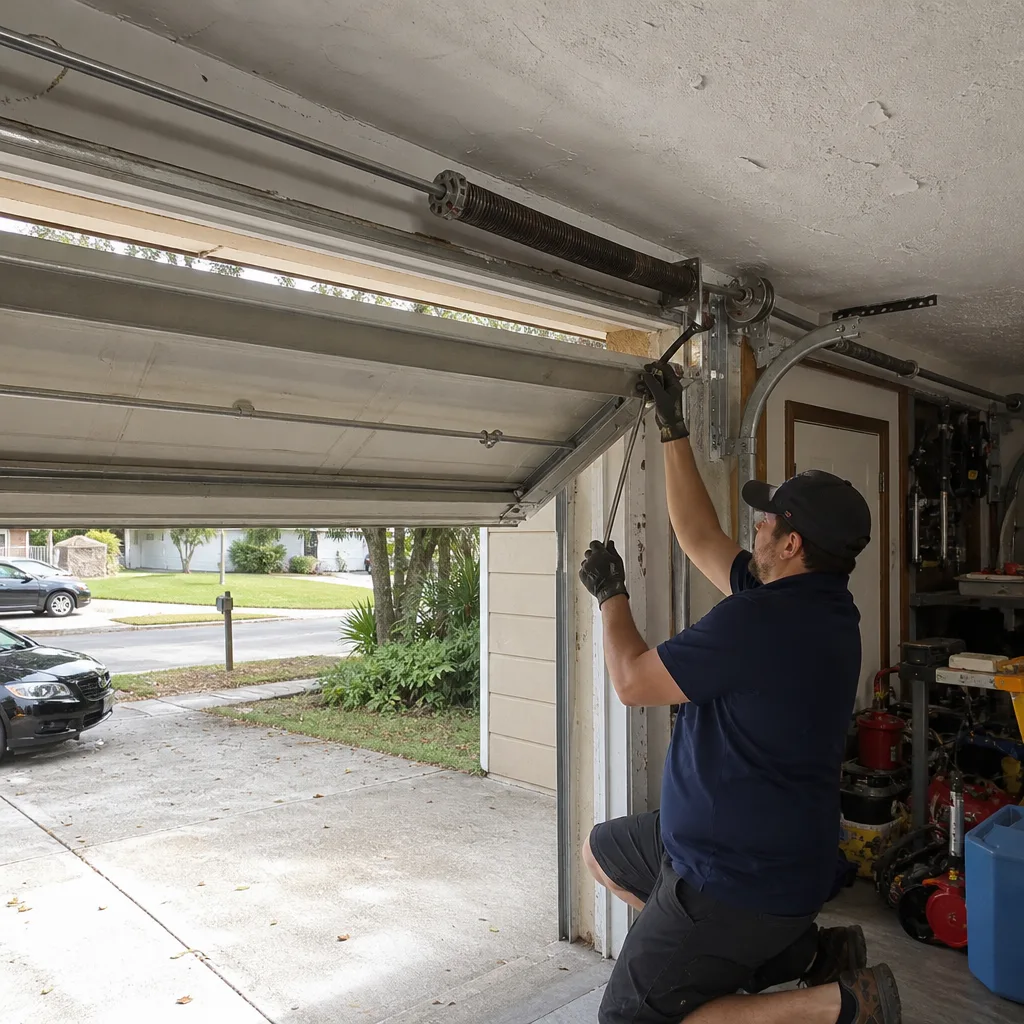
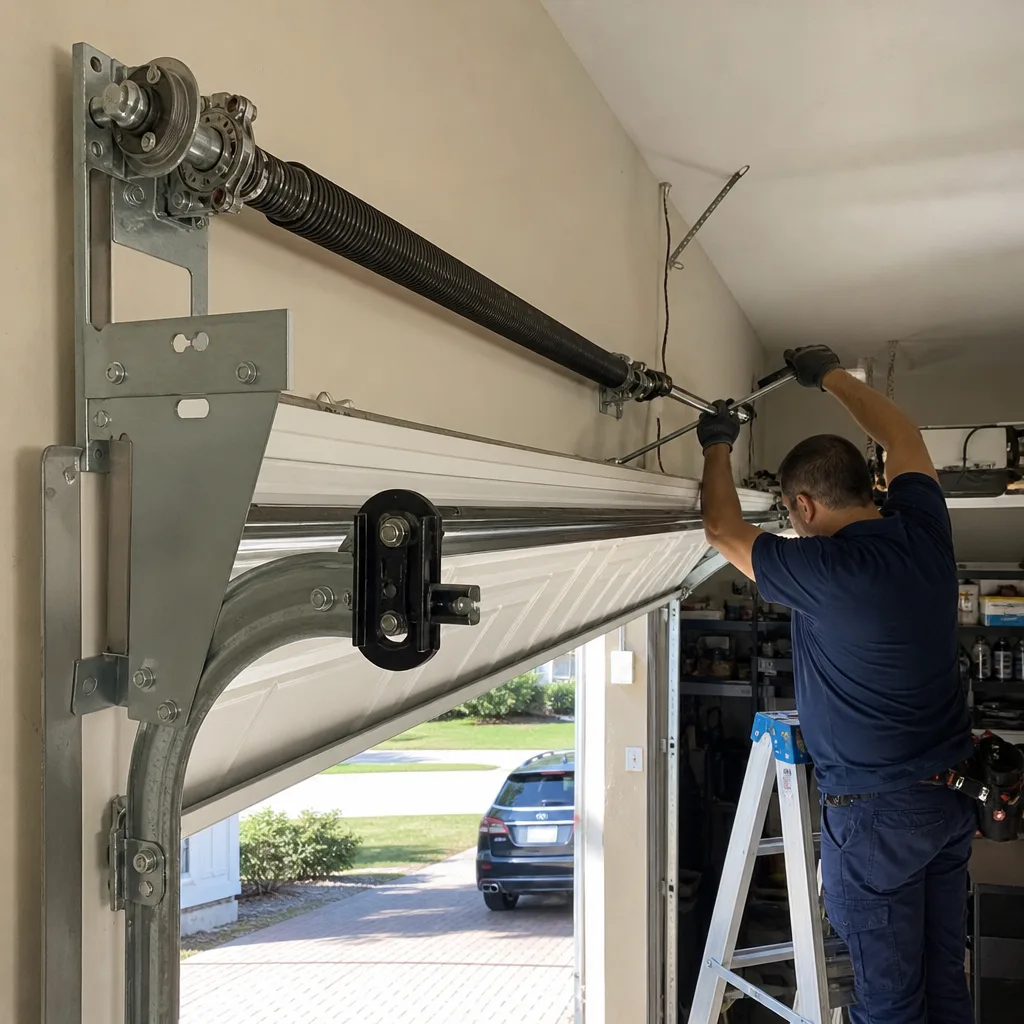
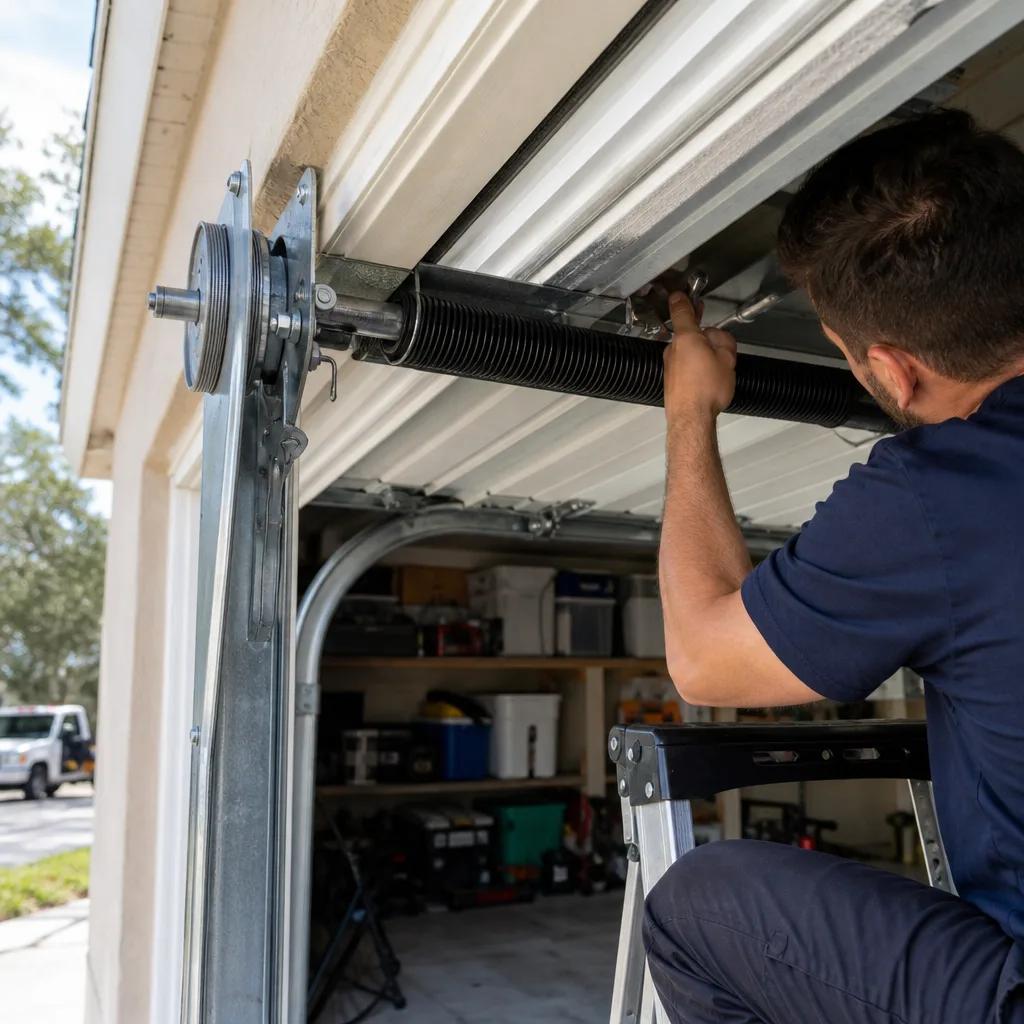
Springs. Torsion springs, the horizontal coils above your door, wind and unwind under extreme tension every time the door cycles. In dry climates, they fail from metal fatigue: the coil simply gives out after a number of cycles. In Orlando, rust accelerates that timeline. Moisture sits on the spring surface overnight, it condenses during the afternoon rain, and micro-pitting begins. The rust weakens the coil at a molecular level. We see springs in Orlo Vista, College Park, and Azalea Park fail years earlier than the manufacturer’s cycle rating suggests, almost always due to corrosion, not pure fatigue.
Cables. Garage door cables are high-tensile steel wound around drums at each side of the door. They’re under constant tension even when the door is open. Salt-air drift from the Atlantic, roughly 45 miles east, and the Gulf, roughly 100 miles west, rides inland on prevailing winds. In zip codes closer to the coasts, like 32822 near the airport or 32828 in East Orlando, we see cable corrosion patterns that don’t show up in Winter Garden or Ocoee with the same intensity. A corroded cable can snap without warning, and that snap releases a dangerous amount of stored energy.
Rollers and hinges. The nylon or steel rollers that let your door ride smoothly in the track wear faster in humid air. Steel rollers rust and seize. Nylon rollers degrade from heat and UV. Hinges collect moisture and the constant thermal expansion and contraction of the door panels loosens them over time. In Orlando’s summer, your garage reaches 110 degrees or more by mid-afternoon, then cools to the 70s by dawn. That daily expansion cycle, repeated 200 times a year, is brutal on fasteners.
The opener. Modern openers are surprisingly robust, but the circuit boards and sensors react to humidity. Condensation inside the opener housing can short sensors or cause intermittent failures. We see more opener logic board failures in Orlando between May and October than in the other seven months combined.
How to Spot Orlando Climate Damage Before It Fails
Catching corrosion early is the difference between a $150 cable replacement and a $700 emergency call when the door comes off its tracks. Here’s the inspection routine we recommend in Orlando, in order.
- Look at the springs monthly. Stand inside the garage, door closed, and inspect the torsion spring above the center of the door. Surface rust is on its way. Deep pitting or any visible crack means the spring is near the end of its life, even if the door still opens.
- Check the cables at the bottom corners. Look for fraying, rust, or strands that appear “unwound” near the cable drum. Frayed cables are a priority repair: they can snap at any time and a snapped cable can send the door off track.
- Listen during operation. A door that used to be quiet and now squeaks, pops, or grinds during opening is telling you something. Grinding often means rusted rollers dragging in the track. Popping can indicate a spring binding. Both are fixable early and expensive later.
- Feel the bottom seal. Orlando’s rain is not uniform: a 20-minute downpour can dump two inches on your driveway while two miles away stays dry. A compromised bottom seal lets that sheet flow into the garage, raising humidity and accelerating every other failure mode. Replace a cracked or flattened seal before June.
- Test the balance. Pull the manual release cord and open the door halfway by hand. If it holds position, the springs are balanced. If it falls, the spring is losing tension and is a candidate for replacement.
If any of these checks reveals a problem, have it addressed before hurricane season. A door that’s already failing won’t survive a tropical storm event. For a full professional inspection with Garage Door Repair in Orlando, we cover every component and provide a written condition report.
Choosing the Right Door Material for Florida UV and Humidity
Orlando’s UV index regularly hits 10 or higher in summer, and a south-facing garage door absorbs hours of direct sunlight that reaches 140 degrees on the panel surface. Then it rains and the panel cools 60 degrees in minutes. That’s a thermal shock cycle. Choosing the wrong material means a sagging, faded, or delaminating door within five years. Choosing the right one means a door that looks good for 15.
Steel doors. Steel is the most common choice in Orlando and, frankly, a good one if you choose the right gauge and finish. Look for 24-gauge or 25-gauge steel minimum. Thinner 27-gauge or 28-gauge panels dent more easily in hail and can flex in high winds. The finish matters more than the gauge: a factory-baked polyester finish stands up to Florida UV, while cheaper painted finishes fade and chalk within a few seasons. In our experience, Amarr and Wayne Dalton steel doors with their premium finishes hold color noticeably longer in direct Orlando sun than bargain doors.
Aluminum doors. Aluminum resists rust, which seems ideal for a humid climate. But aluminum dents easily and transfers heat freely. In Orlando’s summer, an aluminum door facing west will radiate enough heat into the garage to make it unusable as a workspace in the afternoon. Aluminum works best in full-view modern doors with glass panels, where the manufacturer has already engineered the frame for the load. For a standard residential door, steel is the safer bet.
Fiberglass doors. Fiberglass resists salt air and rust. But it’s brittle. Oak branches, palm fronds, and hurricane debris can crack it. Fiberglass also doesn’t hold up well to the constant UV unless the gel coat is high quality. It’s a niche choice in Orlando, not a mainstream one.
Wood doors. Avoid solid wood in Orlando unless you’re committed to maintenance every 12 months. Wood absorbs the humidity, swells, warps, and rots. Painted or stained wood doors on Orlando homes need sanding, sealing, and repainting annually to survive. Composite doors that mimic wood grain give you the look without the rot problem.
Regardless of material, three features matter more in Orlando than anywhere else: a factory-applied finish rated for coastal UV, galvanized or stainless hardware, and a bottom seal designed for standing water collection.
Hurricane-Rated Doors and Orange County Code: What You Actually Need
This is the most misunderstood subject in Orlando garage doors. Before we dive in, see our full breakdown of Garage Door Permits, Codes & Inspections in FL: What You Need to Know. Now let’s clear it up directly: Orange County code requires garage doors to be wind-load rated if the home was built or substantially renovated after the Florida Building Code took effect, which is 2002 on the current edition cycle. That means most Orlando homes built since the early 2000s have a wind-rated door already. Homes built before then may not.
A hurricane-rated door is tested to withstand positive and negative wind pressure without blowing in or being sucked out. When a garage door fails in a hurricane, the wind enters the garage, pressurizes the interior, and the roof lift effect can remove the roof entirely. So the garage door is structural, not cosmetic. That’s the technical reason the code cares about it.
In Orange County, most of the county sits in the windborne debris region, which means any new garage door or replacement door must meet Miami-Dade or Florida Product Approval standards for wind resistance. If you’re replacing a door, the contractor should pull a permit and the new door should carry a NOA or Florida approval number. If you’re repairing a door, like replacing springs or cables, no permit is required and the existing door keeps its compliance status.
Do you need a hurricane door if your home is older and unrated? You don’t legally have to retrofit it until you replace the door. But practically, in a city that evacuates for Category 3 storms and sits under hurricane watch almost every late summer, a wind-rated door is real insurance. It also matters for your homeowner’s insurance premium. Many Florida insurers discount policies when the home has wind-rated openings, including the garage door.
The Real Cost of Garage Door Services in Orlando
National averages don’t help you. A spring replacement quoted at a national average rate doesn’t account for Orlando’s actual labor market, service density, or part availability. For a detailed look at what drives local pricing, see our Garage Door Cost Breakdown: The Orlando Homeowner’s Reference for 2026. Here are the realistic ranges we see across Orlando in 2025, including the specific factors that move the price up or down.
- Garage door spring replacement (torsion): $150 to $290 per spring, including labor. Most doors have two springs. Orlando homes with heavy wooden doors or oversized two-car doors may have two springs with higher cycle ratings, pushing into the $300 to $350 per spring range.
- Extension spring replacement: $100 to $200 per spring. Less common on newer Orlando homes, but still present on many pre-2002 builds.
- Cable replacement (both sides): $150 to $300. Includes rebalancing the door and testing under load.
- Roller replacement (set of 10 to 12): $120 to $220. Nylon rollers cost slightly more than steel but last longer in Orlando’s climate.
- Track realignment or reinforcement on stucco: $150 to $400 depending on anchor damage. Stucco-mounted tracks that have pulled loose require new anchors and sometimes patching.
- Full door replacement (single-car, entry-level steel): $900 to $1,800 installed, depending on gauge, finish, and wind rating.
- Full door replacement (two-car, mid-grade, wind-rated): $1,800 to $3,500 installed. Amarr and Wayne Dalton doors in this class carry Orlando-relevant wind load ratings and better finishes.
- Opener replacement with installation: $350 to $700 depending on drive type and smart features.
One thing we want to be completely clear about: the price we quote is written and locked before any work starts. You’ll see the exact number in writing, and the invoice matches it. No discovery at the door. No “while we’re at it” additions. That’s not a marketing line; it’s the standard for every service call we run through Garage Door Spring Repair in Orlando and every other repair type.
The Orlando Garage Door Maintenance Calendar
In Orlando, garage door maintenance isn’t a one-time thing. It’s tied to the weather calendar. Do these tasks at the right time and you’ll extend component life by years. Do them at the wrong time and you’ll be fighting the elements.
January to March (dry season, mild temperatures). This is inspection season. The air is driest and the threat of afternoon thunderstorms is lowest. Schedule a full inspection: springs, cables, rollers, hinges, tracks, opener force settings, balance test. Address any corrosion before the humid season starts. This is also the best time for non-urgent replacements and door installations, because urethane and adhesive products cure better in lower humidity.
April to May (pre-hurricane season). Replace the bottom seal if it’s cracked or flat. Check the wind-load hardware on the door, including reinforcement struts and track brackets. If you live in a neighborhood with mature oak canopies, like College Park or Thornton Park, have the tracks checked for debris accumulation from spring pollen and leaf fall.
June to November (hurricane season and daily thunderstorms). This is when we respond to the most emergency calls. Doors fail mid-afternoon when a thunderstorm dumps an inch of rain in 20 minutes and the humidity spikes inside the garage. Keep the door closed during storms when possible, and don’t operate the door during a power flicker event unless the opener has a battery backup. If a cable snaps or a spring breaks during this window, call a professional: the temperature in the garage is over 100 degrees and the tools involved are under dangerous tension.
December (post-season). The storm season ends and the holidays begin. A maintenance visit in December catches damage left over from November’s last storms and gets the door ready for the winter dry season.
Following this calendar consistently is the single highest-ROI habit for an Orlando homeowner. A door that gets professional attention twice a year, in January and June, will consistently outlive a door that’s only touched when it breaks.
Salt-Air Drift and Corrosion in Central Florida Zip Codes
You might think salt air only affects beachfront homes. It doesn’t. Salt particles travel surprisingly far inland on prevailing winds, and Orlando’s geography means parts of the city get more salt exposure than people expect. The Atlantic coast is 45 miles east. The Gulf coast is 100 miles west. Most of the year, prevailing winds come out of the east and southeast, carrying Atlantic salt drift over the eastern half of metro Orlando.
In practice, we see a measurable difference in corrosion rates between east Orlando zip codes like 32828, 32829, and 32825 and west Orlando zip codes like 34786 in Windermere or 34761 in Ocoee. East Orlando springs rust faster. Cables pit sooner. Hinges show surface corrosion within a year or two in some cases. The difference isn’t dramatic between one year and the next, but over five years it’s the difference between a spring that lasts 10,000 cycles and one that fails at 6,000.
Proximity to large lakes matters too. Homes near Lake Apopka, Lake Conway, or the Butler Chain of Lakes get added humidity and, in some cases, visible morning condensation on metal garage hardware. That daily condensation is exactly the condition that accelerates rust. If you live within a half-mile of a large lake, bump your inspection frequency up from annual to twice a year.
What can you do about salt-air corrosion? Galvanized or stainless hardware is the best choice when replacing cables, hinges, or brackets. Lightly lubricating springs with a silicone-based lubricant every six months creates a barrier against condensation. And inspecting regularly, so you catch rust before it becomes structural weakness, is the most practical protection of all.
Stucco-Mounted Tracks and Why Anchoring Matters
Most of America hangs garage door tracks on wood framing. Most of Orlando hangs them on stucco over concrete block or directly on CMU. When a track pulls loose in an Orlando home, the repair is fundamentally different from what a generic guide or YouTube video shows.
Stucco is a brittle material. It doesn’t hold a standard lag screw under repeated vibration the way wood does. Over time, the constant up-and-down motion of the door, combined with thermal expansion, causes the stucco around the anchor to crack. Once cracking starts, moisture enters the crack, and the failure accelerates. We see this on tract homes built in the 1990s and 2000s across neighborhoods like Hunters Creek, Lake Nona, and Waterford Lakes.
Proper repair involves removing the damaged anchor point, assessing the CMU or wood behind the stucco, and installing new anchors rated for the substrate. In some cases, we use epoxy-set threaded anchors into the block. In others, we through-bolt to the interior if the wall cavity allows. The wrong fix, which is just re-screwing into the cracked stucco with a larger screw, holds for six months and fails again. Worse, it widens the crack.
If your garage door track is pulling away from the wall, don’t keep tightening it. Call a professional who understands Orlando construction. The fix costs $150 to $400 depending on anchor damage, and it should be fixed once, correctly. That’s the kind of repair we handle routinely through Garage Door Cable Repair in Orlando, because track and cable failures in Orlando are often two sides of the same problem.
Common Mistakes to Avoid
- Ignoring surface rust on springs. Surface rust is the early warning for spring failure in Orlando’s humidity. A rusty spring isn’t “fine”; it’s degrading. Replace it before it snaps and drops the door.
- Using WD-40 on garage door parts. WD-40 is a solvent and water displacer, not a lasting lubricant. It strips existing grease and leaves metal unprotected. Use silicone-based lubricant on springs and hinges, and white lithium on the opener rail.
- Replacing one spring instead of both. Springs wear at the same rate. If one has snapped, the other is close behind. Replacing both restores balance and prevents a second service call in six months.
- Skipping the bottom seal replacement. A $40 bottom seal prevents standing water, debris, and humidity from entering the garage. Waiting until it’s visibly shredded means months of moisture damage you never saw.
- Choosing a door by price alone. A cheap 27-gauge door from a big-box store won’t hold up to Orlando’s UV and wind. Buy the right gauge and wind rating for this climate, not the cheapest option on the shelf.
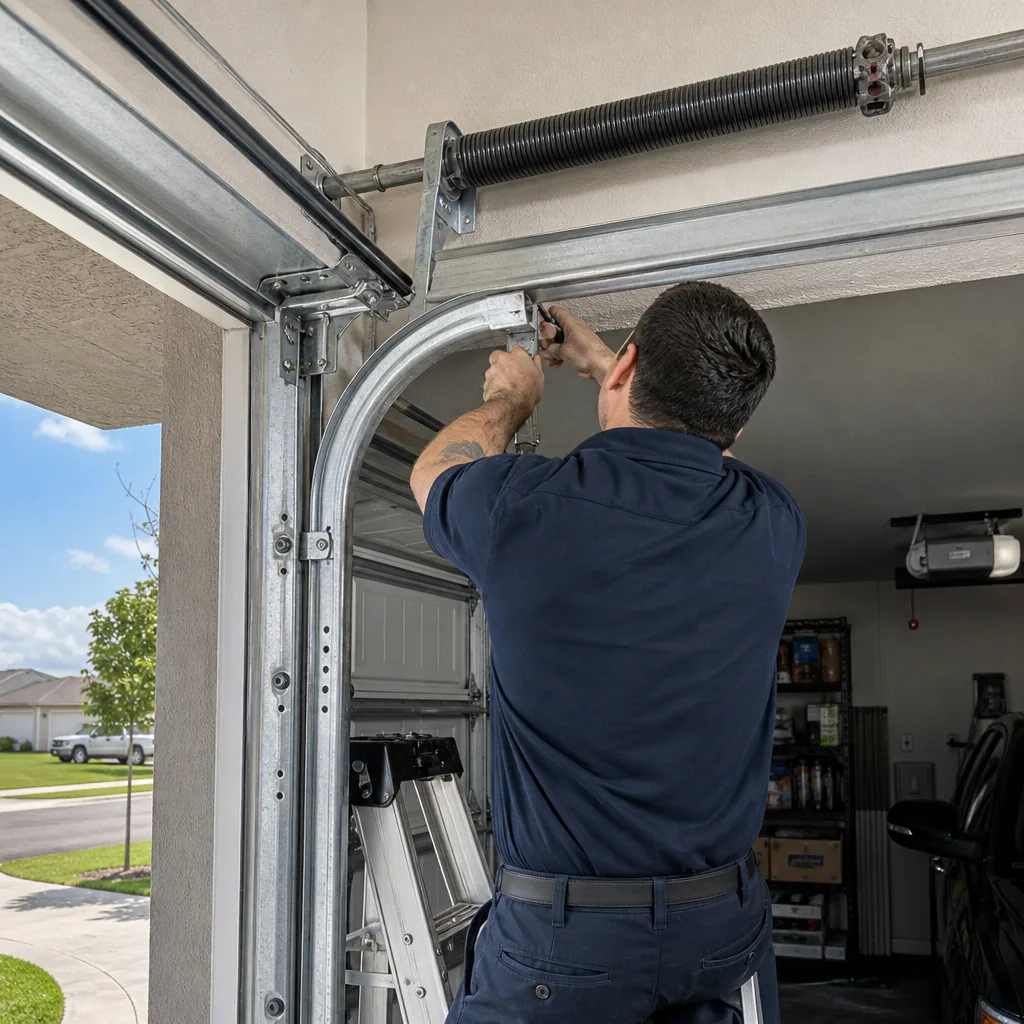
- DIY spring replacement. Torsion springs hold enough stored energy to kill. Untrained attempts to remove and replace them cause serious injuries every year in Florida. This is a job for a professional, period.
- Assuming a pre-2002 door is hurricane-rated. If your home predates the Florida Building Code’s wind-load requirements, your garage door may have no wind rating. Verify before hurricane season, especially if you’re putting that door between your house and a storm.
When to Call a Professional
A snapped torsion spring. A frayed cable. A door that’s come off its tracks. A track anchor pulled loose from stucco. A door that suddenly won’t open or close and you can’t identify why. A door that fell while opening and is now sitting crooked in the opening. Any of these scenarios is a call-us-now situation. These repairs involve high-tension components, 150-pound door panels, or structural anchors, and the consequences of getting them wrong are serious. If you’re weighing whether to tackle it yourself, read our DIY vs Professional Garage Door: The Orlando Homeowner’s Decision Guide first. A real professional knows the danger zones and works with the right tools and the right process.
Marlow Garage Door Repair Orlando offers free estimates across Orlando, and the written price comes before any work starts. Call (850) 790-4744 and a live person answers, day or night.
Frequently Asked Questions
Torsion spring replacement in Orlando runs $150 to $290 per spring, including labor, and most doors have two springs. Extension springs cost $100 to $200 per spring. You’ll get the exact written price before any work starts. Call (850) 790-4744 for a free estimate specific to your door.
A quality steel door with a factory-baked finish typically lasts 15 to 20 years in Orlando if maintained at least annually. Springs last 6 to 10 years depending on cycle count and corrosion exposure, and cables last 5 to 8 years. Homes closer to the coast or to large lakes will see shorter component lifespans.
If your home was built after 2002 or you’re replacing a door, yes, the door must meet Florida wind-load requirements under Orange County code. Older homes may not have a rated door, and retrofitting before hurricane season is a smart safety move even when not legally required.
In most cases, yes. For spring or cable failures, we carry the parts on the truck and complete the repair in a single visit. You’ll see your technician’s live arrival time before they get there. Call (850) 790-4744 and a real person will help you right now.
No. The written price you approve is the price on the invoice, every time. If we find an additional issue during the repair, we show you the written price for that work and get your approval before touching it. No surprises at the door.
Daily condensation from high humidity, combined with salt-air drift from the coasts, accelerates surface rust and micro-pitting on springs. A spring rated for 10,000 cycles in a dry climate can fail at 6,000 cycles in Orlando. Regular inspection and lubrication slow the process but don’t stop it entirely.
The Bottom Line
Orlando’s garage doors fail differently than doors in other parts of the country. The humidity, salt-air drift, intense UV, stucco construction, and hurricane code requirements mean your maintenance schedule, material choices, and repair priorities should all be tailored to this city. A steel door with a quality finish, galvanized hardware, and hurricane wind loading will serve you well. Annual inspections in January and June will catch corrosion before it becomes failure. And when something does fail, call a professional who knows Orlando construction and gives you a written price before any work starts. That’s how your garage door lasts 15 years instead of 5.
Written by Jaylen Ross, Owner at Marlow Garage Door Repair Orlando, serving Orlando since 2002.
See the difference
 Before
 After
After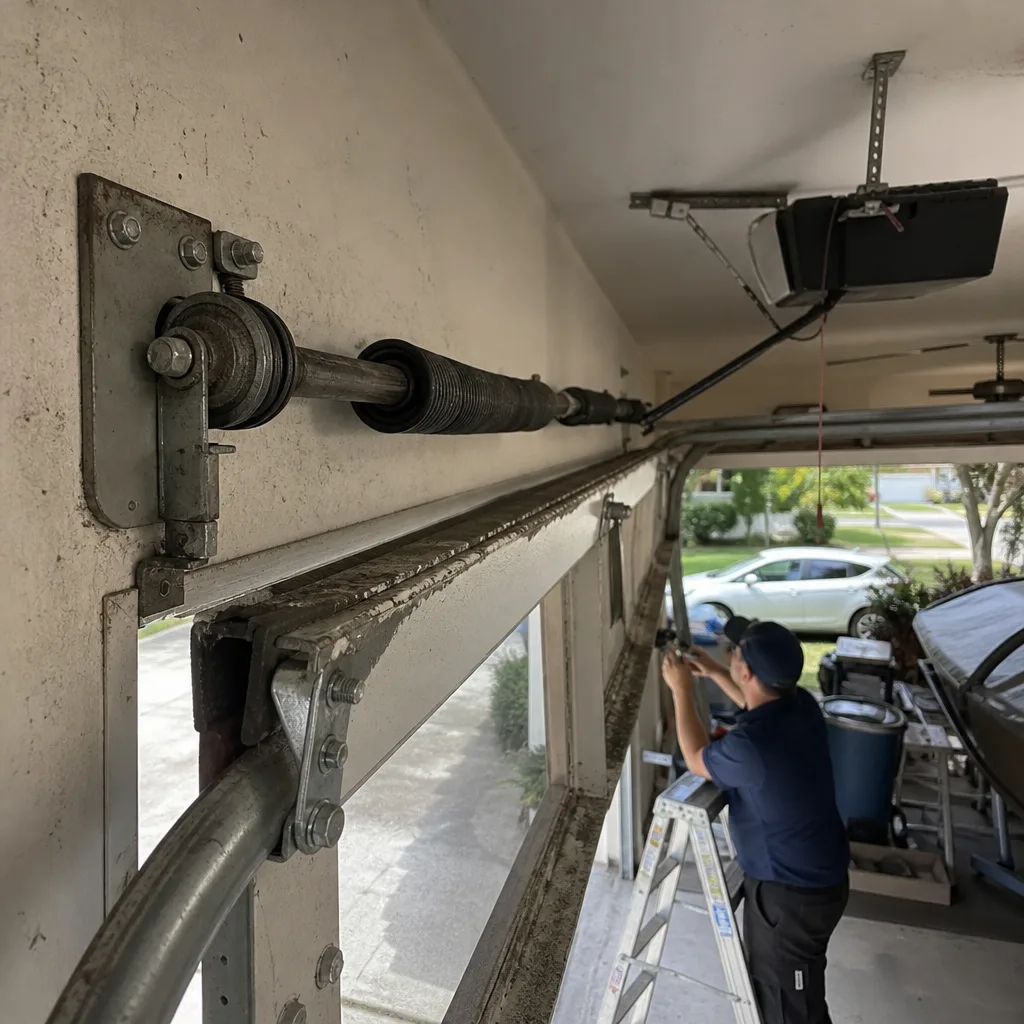 Before
 After
After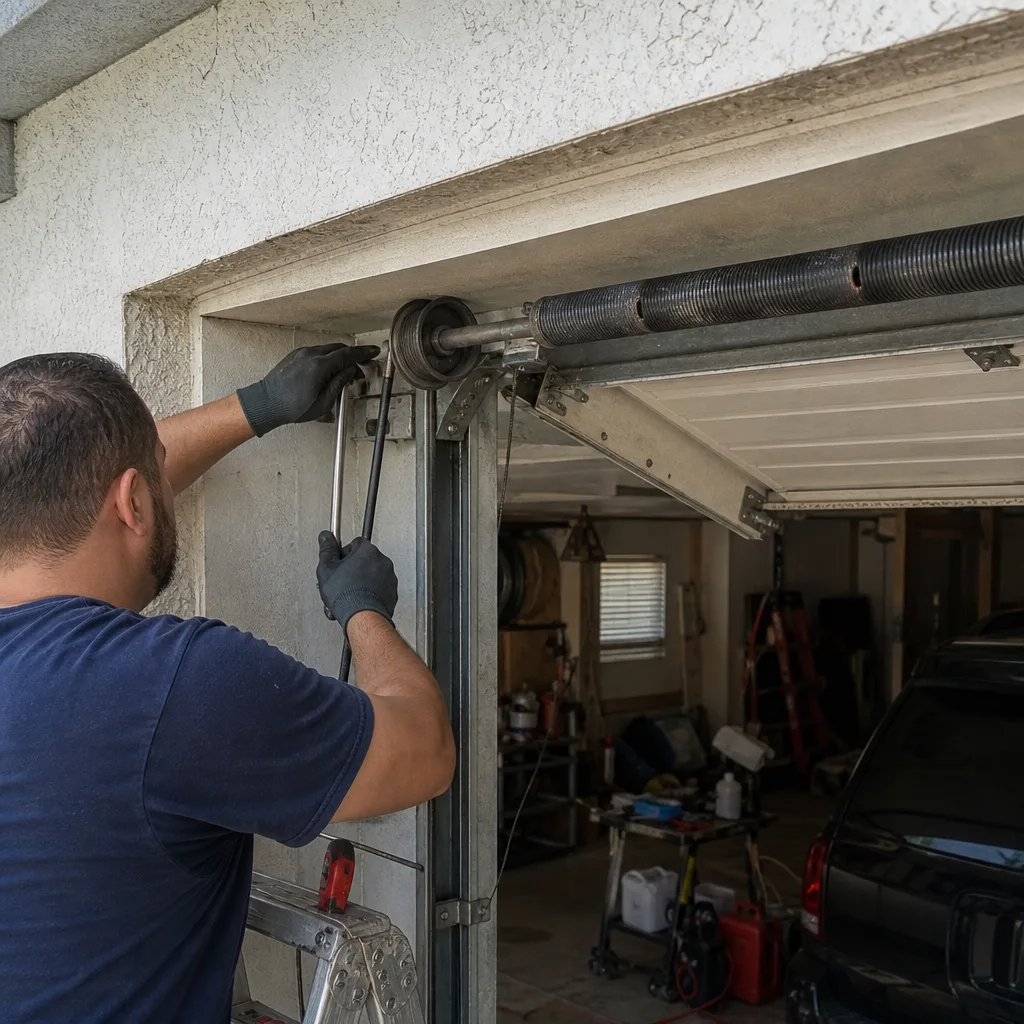 Before
 After
After